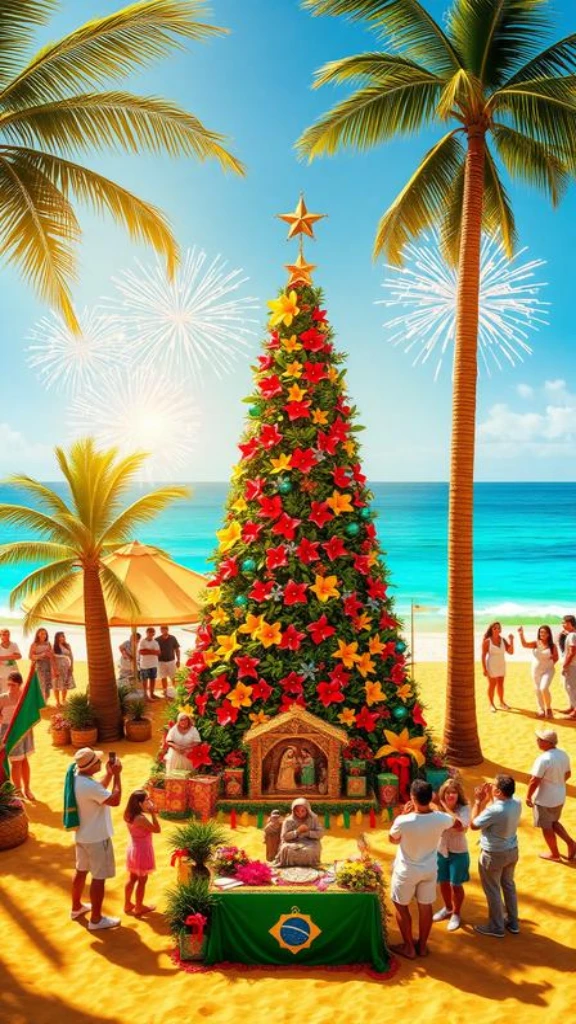
Santa in swim trunks, Christmas supper on the beach, and fireworks replacing snowflakes. Welcome to Christmas in Brazil, where the festive spirit meets summer sunlight!
I’ll never forget the first time I learned that Brazilians celebrate Christmas in 80-degree weather—it utterly flipped my winter wonderland thoughts upside down.
If you think you know Christmas, wait till you discover how Brazil throws the most lively, warm-hearted, and just intriguing festive celebration in the world.
Get ready to uncover over 150 fascinating facts that’ll make you want to book a December flight to Rio!
Fun Facts About Christmas in Brazil for Kids
- Brazilian kids leave their shoes by the window for Papai Noel (Father Christmas) to fill with presents instead of hanging stockings!
- Children often go to bed excited because Christmas happens during their summer vacation—no school, just beaches and parties.
- Many Brazilian families set up nativity scenes called “presépios” with tiny figures that kids love to arrange and rearrange.
- Kids participate in “amigo secreto” (secret Santa) at school, which makes gift-giving extra mysterious and fun.
- Brazilian children write letters to Papai Noel and sometimes send them with colorful drawings of tropical Christmas trees.
- The Christmas season starts right after Children’s Day on October 12th, giving kids months of excitement.
- Many Brazilian kids attend Missa do Galo (Rooster’s Mass) at midnight, staying up way past their bedtime for this special tradition.
- Children love decorating their homes with colorful lights that make neighborhoods look like rainbow wonderlands.
- Brazilian kids get to enjoy Christmas at the pool or beach—imagine opening presents in your swimsuit!
- Young carolers go door-to-door singing traditional songs, often receiving candy and treats from neighbors.
- Kids in Brazil learn that Baby Jesus brings the presents, not just Santa, adding a sweet religious twist.
- Many children participate in Christmas plays at church, dressing up as angels, shepherds, and wise men.
- Brazilian kids countdown to Christmas with advent calendars filled with chocolates that melt faster in the summer heat!
- Fireworks displays on Christmas Eve are so spectacular that kids stay up just to watch the sky light up.
- Children love making paper decorations and colorful chains to hang around their homes and schools.
- Young Brazilians often receive new summer clothes as Christmas gifts—practical and perfect for the season.
- Kids enjoy special Christmas treats like panetone (sweet bread) that they can eat for breakfast all week long.
- Brazilian children learn traditional Christmas songs in Portuguese that sound completely different from English carols.
- Many kids visit shopping malls to take photos with Papai Noel, who’s often sweating under his red suit!
- The excitement of summer Christmas means kids can play outside all day and still enjoy the holiday magic at night.
Fun Facts About Christmas in Brazil for Students
- Brazil is the only Portuguese-speaking country in South America, making its Christmas traditions linguistically unique on the continent.
- The official start of Brazilian Christmas is December 1st when major cities light up their decorations simultaneously.
- Students studying Brazilian culture learn that Christmas blends Catholic, Indigenous, and African traditions beautifully.
- The Brazilian Christmas season technically extends until January 6th, which is Three Kings’ Day or “Dia de Reis.”
- Academic research shows that Brazilian Christmas spending ranks among the highest in Latin America annually.
- Students of religion discover that 65% of Brazilians identify as Catholic, heavily influencing Christmas celebrations.
- The tradition of “Missa do Galo” dates back to the 4th century, making it one of the oldest Christmas customs.
- Brazilian Portuguese has unique Christmas vocabulary that language students must learn, like “Feliz Natal” for Merry Christmas.
- Sociology students study how Christmas in Brazil demonstrates the country’s remarkable cultural syncretism.
- The economic impact of Christmas in Brazil shows retail sales increase by approximately 40% during December.
- Students learn that Brazil’s Christmas falls during the summer solstice, the longest day of the year in the Southern Hemisphere.
- Historical records show Portuguese colonizers introduced Christmas to Brazil in the 16th century.
- Geography students note that Christmas celebrations vary significantly between Brazil’s five distinct regions.
- Music students discover that Brazilian Christmas carols incorporate samba, bossa nova, and forró rhythms.
- The study of Brazilian immigration patterns reveals how Italian and German settlers influenced Christmas food traditions.
- Anthropology students explore how Indigenous Brazilians adapted European Christmas customs to their own culture.
- Environmental science students examine the debate over cutting down pine trees for Christmas in a tropical country.
- Economics students analyze how the “13th salary” (Christmas bonus) affects consumer behavior during the holidays.
- Art students study the elaborate decorations and folk art traditions that make Brazilian Christmas visually stunning.
- Cultural studies reveal that Brazilian Christmas emphasizes family gatherings more than gift-giving compared to Western countries.
Christmas in Brazil Traditions
- The “Amigo Secreto” gift exchange happens at nearly every workplace, school, and family gathering throughout December.
- Families traditionally gather for a late dinner on Christmas Eve, often starting after 10 PM and lasting until midnight.
- Opening presents happens right at midnight after everyone exchanges hugs and says “Feliz Natal!”
- The Missa do Galo (Rooster’s Mass) at midnight is attended by millions of Brazilians across the country.
- Many families light candles and place them in windows to guide the Christ child to their homes.
- Brazilians traditionally kiss everyone present at midnight—family members, friends, and even acquaintances get warm embraces.
- The Christmas lottery called “Loteria de Natal” is a beloved tradition where everyone tries their luck.
- Setting up elaborate nativity scenes is considered more important than decorating Christmas trees in many homes.
- Beach communities celebrate with bonfires on the sand, combining Christmas cheer with coastal culture.
- Wearing white clothing on Christmas Eve is a tradition believed to bring peace and good luck for the coming year.
- Many Brazilians attend multiple Christmas celebrations—one with family, another with friends, and sometimes a third with coworkers.
- The tradition of “Noite Feliz” involves singing “Silent Night” in Portuguese as midnight approaches.
- Releasing biodegradable balloons with wishes written on them was once popular, though now discouraged for environmental reasons.
- Exchanging Christmas cards remains popular, with many families sending photo cards showing their summer activities.
- The “Ceia de Natal” (Christmas supper) traditionally includes exactly 12 dishes, though this varies by region.
- Many cities organize massive Christmas parades with elaborate floats and performers in festive costumes.
- Decorating homes with tropical flowers like poinsettias and orchids adds a uniquely Brazilian touch to Christmas décor.
- The tradition of “Cantata de Natal” involves church choirs performing elaborate Christmas concerts throughout December.
- Some families exchange small gifts throughout December, not just on Christmas Eve, extending the celebration.
- Brazilian grandmothers traditionally prepare special Christmas recipes that have been passed down for generations.
- Setting off fireworks at midnight is so widespread that entire neighborhoods light up simultaneously.
- Many communities organize “Papai Noel nos Correios” where children’s letters to Santa are answered by volunteers.
- The tradition of visiting friends and family on Christmas Day itself continues, with people traveling house to house.
- Some regions practice “Folia de Reis,” where groups travel singing and performing from December 25 to January 6.
Christmas in Brazil for Kids
- Brazilian children often attend Christmas parties at school before vacation starts, with games and treats galore.
- Kids eagerly participate in decorating their homes, creating colorful paper stars and chains from scratch.
- Many children receive new toys that are perfect for outdoor summer play, like water guns and beach equipment.
- Young Brazilians learn to appreciate both the religious and festive aspects of Christmas from an early age.
- Kids love the excitement of staying up late on Christmas Eve, which feels extra special since it’s usually forbidden.
- Brazilian children often help prepare traditional foods, learning family recipes that they’ll pass down someday.
- Many kids collect “figurinhas” (stickers) with Christmas themes, trading them with friends during December.
- Children participate in school nativity plays, often rehearsing for weeks to perfect their performances.
- Brazilian kids write “cartinhas” (little letters) to Papai Noel with detailed wish lists and promises to be good.
- Young ones enjoy Christmas movies dubbed in Portuguese, with classic stories given a Brazilian flavor.
- Kids visit elaborate Christmas light displays in their cities, which become magical evening adventures for families.
- Many Brazilian children receive books as gifts, encouraging reading during the long summer vacation ahead.
- Young carol singers practice traditional songs to perform at family gatherings and neighborhood celebrations.
- Kids help set up the family presépio, carefully placing each figurine in the nativity scene.
- Brazilian children often receive “mesada” (allowance) to buy small gifts for family members, teaching them generosity.
- Young ones participate in charity drives, learning to share with less fortunate children during Christmas.
- Kids enjoy special Christmas television programming, including Brazilian-made holiday specials and cartoons.
- Many children attend “colônias de férias” (vacation camps) where Christmas-themed activities continue the celebration.
- Brazilian kids love telling their friends about what Papai Noel brought them, comparing presents excitedly.
- Young Brazilians experience the unique joy of having their birthday close to Christmas if born in December, though presents sometimes get combined!
Christmas in Brazil Food
- Tender roasted turkey with “farofa” (toasted cassava flour mixture) is the centerpiece of most Brazilian Christmas dinners.
- Peru (turkey) prepared with Brazilian seasonings tastes completely different from American-style roast turkey.
- Chester (a special breed of tender chicken) is actually more popular than turkey in many Brazilian households.
- Bacalhau (salted cod) dishes represent Portuguese heritage and appear on countless Christmas tables.
- Ham glazed with pineapple and honey brings a sweet-savory flavor that Brazilians absolutely adore.
- Tender pork loin roasted with prunes and apricots adds an elegant touch to the Christmas feast.
- Colorful rice dishes studded with raisins, nuts, and vegetables make the dinner table look festive and inviting.
- Creamy salpicão (chicken salad) with apples, corn, and potato sticks is a must-have at every gathering.
- Fresh summer salads featuring mango, papaya, and tropical fruits balance the heavy main courses perfectly.
- Farofa made with bacon, eggs, nuts, and dried fruits transforms a simple side dish into a celebration.
- Traditional panetone, the sweet Italian bread, has become so Brazilian that people eat it all through January.
- Chocotone (chocolate panetone) divides Brazilian families—some swear by it, others remain traditionalists.
- Rabanada, the Brazilian version of French toast soaked in wine and cinnamon, is Christmas breakfast perfection.
- Tender pernil (leg of pork) roasted for hours becomes fall-apart delicious and feeds the whole extended family.
- Creamy lentil dishes are eaten at midnight for good luck and prosperity in the coming year.
- Sonho (cream-filled donuts) appears at many Christmas celebrations, bringing sweetness to the festivities.
- Fresh tropical fruit salads provide a refreshing contrast to the rich, heavy traditional dishes.
- Arroz à grega (Greek-style rice) with colorful vegetables makes every plate Instagram-worthy.
- Tender chicken with catupiry (Brazilian cream cheese) represents modern Brazilian-Italian fusion cuisine.
- Farofa de banana brings an unexpected sweet element to the savory dinner spread.
- Nuts and dried fruits arranged in decorative bowls stay on the table for guests to nibble all evening.
- Sparkling grape juice or champagne accompanies the midnight toast—”Um brinde!”
- Brigadeiros, those beloved chocolate truffle-like treats, often appear in Christmas colors of red, green, and white.
- Tender codfish cakes (bolinhos de bacalhau) serve as popular appetizers before the main feast begins.
- Maionese (Brazilian potato salad) includes vegetables, eggs, and sometimes even apples for unexpected crunch.
Brazil Christmas Decorations
- Artificial Christmas trees actually outnumber real ones since pine trees aren’t native to most of Brazil.
- Tropical flowers like red anthuriums and orchids often decorate Christmas trees instead of traditional ornaments.
- Colorful string lights transform entire neighborhoods into dazzling displays of red, green, gold, and blue.
- Elaborate nativity scenes take center stage in homes, often featuring miniature Brazilian landscapes and villages.
- Paper decorations in bright colors hang from ceilings, creating festive canopies in living rooms.
- Window displays feature cotton “snow” to create a winter feeling despite the summer heat outside.
- Inflatable Santas and snowmen appear on rooftops and lawns, creating amusing contrasts with palm trees.
- Brazilian Christmas wreaths incorporate tropical elements like coconuts, small pineapples, and bright hibiscus flowers.
- Glittery stars hang from doors and windows, catching the sunlight in spectacular ways.
- Shopping malls compete for the most elaborate decorations, drawing crowds who come just to photograph them.
- Churches create stunning Christmas displays with life-sized nativity figures that take weeks to assemble.
- Balconies and terraces get decorated with potted poinsettias that thrive in the warm Brazilian climate.
- City squares install massive Christmas trees—sometimes reaching 100 feet tall—visible from blocks away.
- Handmade ornaments crafted from recycled materials reflect Brazilian creativity and environmental consciousness.
- Colorful fabric banners with “Feliz Natal” messages hang across streets in smaller towns and neighborhoods.
- Brazilian homes often feature multiple nativity scenes in different sizes scattered throughout the house.
- LED projections of snowflakes and reindeer on building facades create winter wonderland illusions.
- Tropical-themed ornaments like parrots, toucans, and palm trees appear on many Christmas trees.
- Glass ornaments in Brazilian flag colors (green, yellow, and blue) add patriotic pride to decorations.
- Outdoor dining areas get decorated with fairy lights and garlands since families dine outside in warm weather.
- Children create construction paper decorations at school that proudly display at home—angels, stars, and bells.
- Store windows feature elaborate scenes combining traditional Christmas imagery with Brazilian elements.
- Some families create “presépio vivo” (living nativity) displays with people in costume in their front yards.
- Ribbon and tinsel in metallic colors drape across everything, creating maximum sparkle and shine.
Best Fun Facts About Christmas in Brazil
- Brazil has Christmas in summer, with temperatures often reaching 95°F (35°C) on December 25th!
- The world’s tallest floating Christmas tree appears annually in Rio de Janeiro’s Rodrigo de Freitas Lagoon.
- Brazilian Christmas dinner happens late—most families don’t sit down to eat until 10 PM or later.
- Papai Noel (Brazilian Santa) wears traditional red velvet despite the scorching summer heat—talk about dedication!
- Brazilians receive a “13th salary” in December, essentially a mandatory Christmas bonus from employers.
- Christmas in Brazil is more about family gatherings than commercial gift-giving compared to North America.
- The celebration officially lasts from December 24 to January 6, giving Brazilians nearly two weeks of festivities.
- Brazilians kiss everyone present at midnight on Christmas Eve—expect lots of warm hugs and cheek kisses!
- Secret Santa (Amigo Secreto) happens everywhere—at work, school, among friends, and even in neighborhood groups.
- Many Brazilians celebrate Christmas at the beach, with some families having their dinner on the sand.
- Fireworks at midnight rival New Year’s Eve displays, lighting up the sky in spectacular fashion.
- Brazilian Christmas carols blend traditional Portuguese songs with samba and bossa nova rhythms.
- The country decorates so early that Christmas lights appear in November, extending the festive season.
- Wearing white on Christmas Eve is believed to bring peace and good fortune for the coming year.
- Nativity scenes matter more than Christmas trees in traditional Brazilian homes—they’re the real stars.
- Brazilian children believe Papai Noel lives in Greenland and travels to Brazil just for their celebration.
- Christmas in Brazil emphasizes religious observance—millions attend midnight Mass on Christmas Eve.
- Some Brazilian cities recreate European Christmas villages complete with fake snow and winter decorations.
- The tradition of eating lentils at midnight supposedly brings prosperity—each lentil represents a coin.
- Brazilian Christmas lasts all night—parties continue until dawn, with people opening presents at midnight.
- Tropical fruits appear in Christmas decorations and dinner menus, creating a uniquely Brazilian experience.
- Some families exchange gifts throughout December rather than all at once, extending the joy.
- Brazilian Christmas combines Catholic traditions with African and Indigenous cultural elements beautifully.
- The celebration is so important that businesses close early on Christmas Eve to let everyone prepare.
- Christmas in Brazil proves that holiday spirit doesn’t need snow—just warmth, love, and togetherness!
Conclusion
There you have it—over 150 amazing facts about how Brazil celebrates the most delightful (and warmest!) time of the year! Whether you’re a student researching ethnic traditions, a parent looking to teach kids about worldwide festivities, or simply someone who loves understanding how different countries celebrate, Brazilian Christmas provides countless surprises.
From midnight feasts to beachside celebrations, from Papai Noel in velvet to tropical nativity scenes, Brazil illustrates that Christmas charm transcends climate and region.
So next time someone mentions Christmas, why not drop a truth about Brazilian summer celebrations? After all, nothing says “ho-ho-hot” quite like celebrating in a swimsuit! Feliz Natal!